
The Utility Flow Diagram shows the piping, valves, and instrumentation for the basic plant utilities. Utilities are services that are essential to the proper function of the plant. These utilities correspond to some of the same utilities used in a typical house, such as water, gas, and sewer drains. Some of the common plant utilities are:
• steam
• condensate
• fuel oil
• utility air
• instrument air
• cooling water
• drainage systems
• flare system
Utility Flow Diagram
Mechanical Flow Diagram

From the Process Flow Diagram, the mechanical group develops the Mechanical Flow Diagram. The mechanical flow diagram provides much more detailed data than the Process Flow Diagram. Mechanical Flow Diagrams include the following:
1. Pipe line numbers and direction of flow
2. Pipe specifications and line sizes
3. All equipment
4. All valves
5. All instrumentation with controlling devices
Process Flow Diagram
The process flow diagram is the first flow diagram developed by the flow diagram department. It shows the relationships between the major components in the system and includes the following:
1. Major equipment
2. Main piping
3. Direction of flow
4. Operating pressure and temperature
5. Major instrumentation
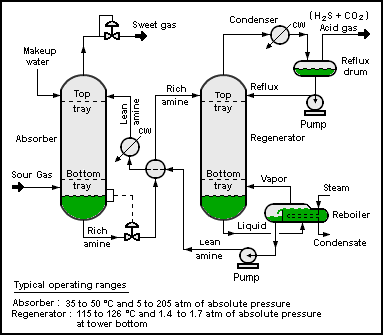
Process diagram
The ‘process’ is an idea or concept that is developed to a certain level in order to determine the feasibility of the project. ‘Feasibility’ study is the name given to a small design project that is conducted to determine the scope and cost of implementing the project from concept to operation. To keep things simple, for example, design an imaginary coffee bottling plant to produce bottled coffee for distribution. Start by creating a basic flow diagram that illustrates the objective for the proposed plant; this diagram is called a “Process Block Diagram”.
Type of Flow Diagrams
Process engineers are responsible for developing flow diagrams. In many large engineering firms, an entire department is dedicated to the development of flow diagrams. Today almost all flow diagrams are laid out with CAD, using third-party piping packages such as Pro-Flow or individually developed company packages.
1. Process Flow Diagram
2. Mechanical Flow Diagram
3. Utility Flow Diagram
Piping and Instrumentation Diagram (P&ID)
The Piping & Instrumentation Diagram, which may also be referred to as the Process & Instrumentation Diagram, gives a graphical representation of the process including hardware (Piping, Equipment) and software (Control systems); this information is used for the design construction and operation of the facility.
The PFD defines “The flow of the process” The PFD covers batching, quantities, output, and composition.
The P&ID also provides important information needed by the constructor and manufacturer to develop the other construction input documents (the isometric drawings, or orthographic physical layout drawings, etc.). The P&ID provides direct input to the field for the physical design and installation of field-run piping. For clarity, it is usual to use the same general layout of flow paths on the P&ID as used in the flow diagram.
The P&ID ties together the system description, the flow diagram, the electrical control schematic, and the control logic diagram. It accomplishes this by showing all of the piping, equipment, principal instruments, instrument loops, and control interlocks. The P&ID contains a minimum of text in the form of notes (the system description minimizes the need for text on the P&ID).
The typical plant operation’s environment uses the P&ID as the principal document to locate information about the facility, whether this is physical data about an object, or information, such as financial, regulatory compliance, safety, HAZOP information, etc.
The P&ID defines “The control of the flow of the process” where the PFD is the main circuit; the P&ID is the control circuit. Once thoroughly conversant with the PFD & Process description, the engineers from the relevant disciplines (piping, electrical & control systems) attend a number of HAZOP sessions to develop the P&ID.
Subscribe to:
Posts (Atom)


 Posts
Posts


